P. Maniyarasan, Leader, Tamil Nationalist Movement (Tamil Desiyap Periyakkam)
Election campaigns are proceeding intensely in Tamil Nadu and West Bengal. Recently, polling was completed on 09.04.2026 in Kerala, Assam, and Puducherry, and both the people and political parties are anxiously awaiting the results. Voting in Tamil Nadu is scheduled for 23.04.2026; in West Bengal on 23.04.2026 and 29.04.2026. Campaigns for these elections are ongoing with great intensity.
In such a situation, Prime Minister Narendra Modi has hastily arranged a parliamentary session for three days—April 16, 17, and 18, 2026. The purpose of convening Parliament in the midst of elections is twofold:
1. To pass a law reserving 33% of parliamentary and assembly constituencies exclusively for women.
2. To increase the number of parliamentary and assembly constituencies in each state based on population growth.
To facilitate such laws, the Narendra Modi government had already passed constitutional amendments in Parliament in 2023. However, for more than thirty months, no action was taken to implement those amendments.
Now, when state assembly elections are underway in several states, why has the idea of women’s reservation suddenly emerged? Why the sudden move to increase constituencies based on population growth?
Is it because the BJP has lost its earlier influence in states currently facing elections? Or is it a strategy to attract women voters in states like Tamil Nadu and West Bengal, where elections are yet to be held? Many such questions arise.
This is because Hindutva, rooted in Aryan ideology, has historically not shown concern for women’s rights. The Manusmriti of Aryan tradition defines all women—including Brahmin women—as subordinate. The RSS and BJP leaders have never rejected this text, which is foundational to Brahminical dominance.
Even so, if women are to receive 33% reservation in Parliament and state assemblies, it may be welcomed as a beneficial step. However, increasing Lok Sabha constituencies based on the 2011 Census would raise the total number of seats to 816.
What is the Dravidian model’s position on this? M.K. Stalin says the current number of constituencies should remain unchanged for now. Why?
The AIADMK has not even spoken about this issue. Must it remain so subservient to Delhi and the BJP?
Population growth has been significantly higher in Hindi-speaking states. As a result, their Lok Sabha seats will increase as follows (numbers in brackets indicate new totals):
1. Uttar Pradesh – 80 (120)
2. Bihar – 40 (60)
3. Madhya Pradesh – 29 (44)
4. Rajasthan – 25 (38)
5. Haryana – 10 (15)
6. Uttarakhand – 5 (8)
7. Himachal Pradesh – 4 (6)
8. Jharkhand – 14 (21)
9. Chhattisgarh – 11 (17)
10. Delhi – 7 (11)
In all these ten states, Hindi is both the administrative and educational language. Together, they currently have 235 Lok Sabha seats.
Gujarat, though officially using Gujarati, has fully embraced Hindi. Many of India’s dominant capitalists, such as Ambani and Adani, are Gujaratis. Hence, they align with Hindi-speaking interests.
Including Gujarat, Hindi-speaking states currently have 261 seats. With the proposed increase, they would have 394 seats.
M.K. Stalin says this increase should be postponed. The Congress party does not fully oppose the increase either; its main objection is to introducing such constitutional changes during elections.
Out of the current 543 Lok Sabha members, Tamil Nadu has only 39. Including Puducherry, that makes 40 seats. Compared to the 261 seats held by Hindi-speaking states, Tamil Nadu’s representation is extremely small—almost invisible—despite having a population of 85 million.
For comparison: Germany has 83.5 million people, the UK 76 million, and France 69 million.
Why then is Tamil Nadu reduced to such insignificance?
India emerged from colonial exploitation by British traders. After independence in 1947, power was transferred to leaders like Nehru, Patel, and Rajendra Prasad—leaders rooted in Aryan-Hindi dominance, with Sanskrit as their sacred language and Hindi as the common language.
The British had organized provinces for administrative convenience. Later, after protests, linguistic states were formed under the States Reorganisation Act of 1956—not explicitly as national-ethnic states.
Even compared to the Government of India Act 1935, the Indian Constitution granted fewer powers to states.
The DMK, founded in 1949, initially demanded independence for Dravidian regions and gained significant public support, winning 15 seats in 1957 and 50 seats in 1962. However, fearing legal restrictions, it abandoned the demand for a separate state.
Today, the DMK and its allies argue that the current number of Lok Sabha seats should remain unchanged. This is seen as maintaining the status quo.
But the current parliamentary system is viewed here as oppressive, with Hindi-speaking states dominating. Tamil Nadu’s 39 representatives are marginal compared to the 260+ from Hindi states.
Above Parliament, the Governor’s office further centralizes control over non-Hindi states.
Thus, maintaining the current structure perpetuates inequality. According to this argument, a true federal system should ensure equal representation for all nationalities.
Within each state, constituencies can be based on population, but at the federal level, all national groups should have equal representation.
The proposal is to dissolve the current Parliament and reconstitute it with equal representation for all nationalities. The central government should only handle defense, currency, and foreign affairs. Governors and provisions to dismiss state governments should be abolished. Taxation powers should rest with states, which would then share a portion with the central government.
Each state language should also be recognized as an all-India administrative and educational language.
At this moment, true democrats must debate these necessary structural changes. One must not oppose new forms of oppression while accepting old ones.
By resisting new injustices, people can also become aware of existing inequalities and build broader awareness.
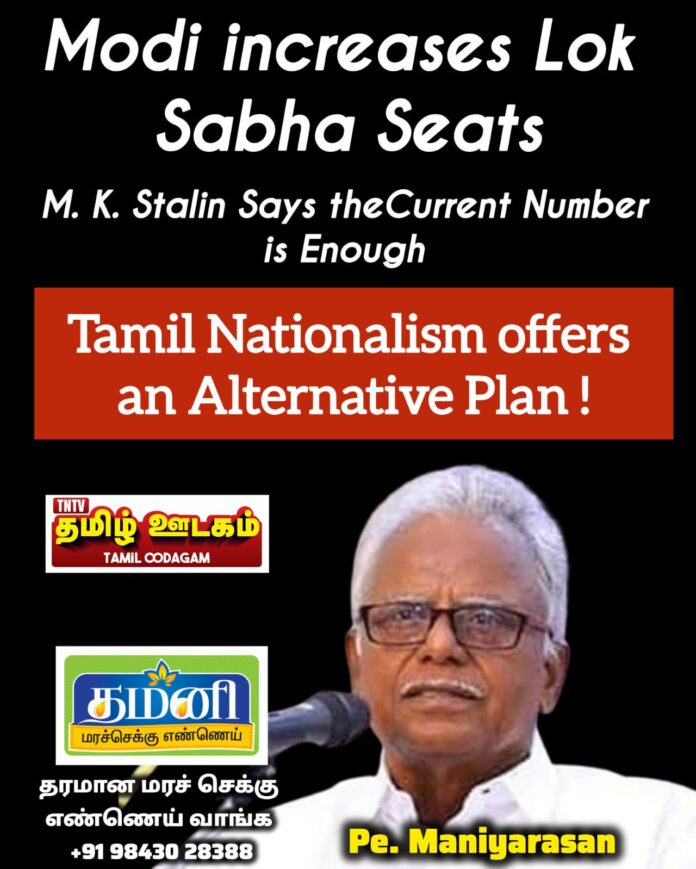
Modi increases Lok Sabha seats! Stalin says the current number is enough !
Tamil Nationalism offers an alternative plan !