
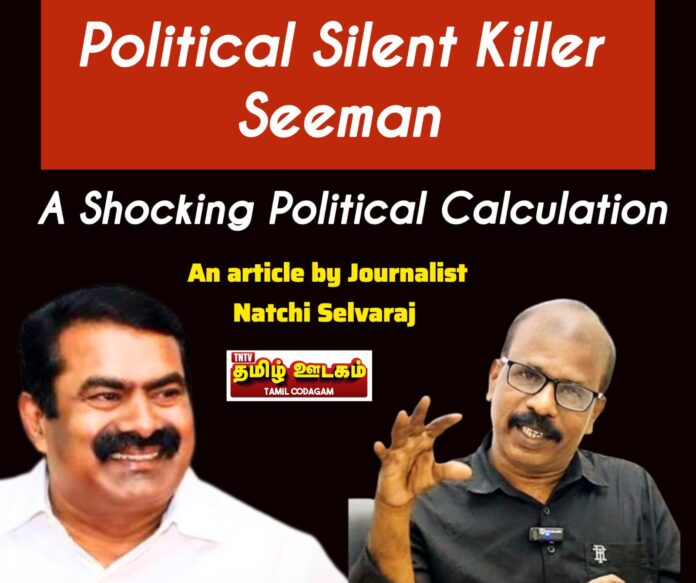
— Natchi Selvaraj, Journalist
In the upcoming Tamil Nadu Legislative Assembly election to be held on the 23rd, regardless of whether the AIADMK or DMK loses, the primary reason for that defeat is likely to be Seeman’s Naam Tamilar Katchi (NTK).
For the past 15 years, Seeman has led NTK as a mass movement and has contested multiple elections.
He has introduced several innovations in politics, setting examples even for other political parties.
For instance, while Indian political parties have only recently begun seriously debating 33% reservation for women in Parliament—nearly 70 years after independence—Seeman not only advocated it but implemented 50% reservation in practice.
He established a firm and uncompromising policy of equal representation: 117 seats for men and 117 for women.
Much like the Russian and Chinese revolutions, Seeman has demonstrated a socio-political transformation in Tamil Nadu.
Beyond prioritizing social reforms, he has also honored key figures who contributed to the Tamil language and Tamil identity—such as Ma. Po. Sivagnanam, Maraimalai Adigal, Kavikko Abdul Rahman, Devaneya Pavanar, Rettamalai Srinivasan, forest guard Veerappan, education reformer Kamarajar, Muthuramalinga Thevar, and Immanuel Sekaran—by commemorating their birth and remembrance days across Tamil Nadu through posters, thereby embedding their legacy into public memory and creating a new political culture.
Instead of wasting time with superficial political rhetoric, Seeman has spoken with long-term vision about strategies to improve Tamil Nadu’s economy.
He has also proposed plans to expand commerce through livestock and integrate it into the state’s revenue framework.
Having sown seeds for various reforms aimed at national development and language preservation, Seeman’s potential impact in the 2026 Assembly elections has left even election strategists uncertain.
That is why he is described here as a “Silent Killer.”
Ground reality suggests that either AIADMK or DMK—two major Dravidian parties—will form the government. The key question is: who will cause the defeat of the losing party? Will it be Seeman or Vijay, the leader of Tamilaga Vettri Kazhagam?
Although Vijay’s party has been criticized, it is contesting elections for the first time, making its electoral impact unpredictable.
However, NTK—despite facing repeated defeats—has consistently remained in the field, and its growing vote share is what now causes concern for both AIADMK and DMK.
Internal conflicts within the DMK alliance have now come into the open.
Allegations of arrogance against DMK leader Stalin, along with Mamata Banerjee’s serious accusation of a covert relationship between the BJP and DMK, have created irreparable rifts within the alliance.
These divisions are likely to reflect in the election results, potentially leading to major political shifts. If such changes occur, several parties in Tamil Nadu may fade away—among them DMDK, MDMK, VCK, Congress, and TVK.
These parties, largely dependent on AIADMK or DMK, are likely to face major setbacks.
In contrast, NTK has grown independently.
The impact on AIADMK and DMK will extend to their allied parties, but NTK remains unaffected as it does not depend on BJP, Congress, AIADMK, or DMK.
Amid these changes, NTK is likely to reinvent itself, gain renewed momentum, and accelerate its political growth—injecting fresh energy into Tamil Nadu politics and preparing for the next phase.
A notable recent development is NTK’s selection of candidates based on what it calls genuine social justice. By allocating 7 seats to Brahmins and announcing candidates accordingly, the party has made a significant impact among that community.
Various associations representing this community in Chennai appear to regard Seeman positively, reflecting the influence of this move.
These factors act as indicators of NTK’s growing impact.
In every constituency, NTK votes are becoming crucial—they could serve as a decisive force capable of defeating a Dravidian party.
In that political calculation, Seeman is likely to emerge successful. This election will also offer him important lessons.
After the election results on May 4, those currently aligned with parties like Congress, DMDK, and VCK may shift towards NTK.
They may come to accept Seeman as a leader with long-term vision. The time for that transition appears to be approaching.
This is the essence of contesting independently without alliances—and Seeman has steadfastly adhered to this principle till the end.
In that sense, isn’t he truly a “Silent Killer”?